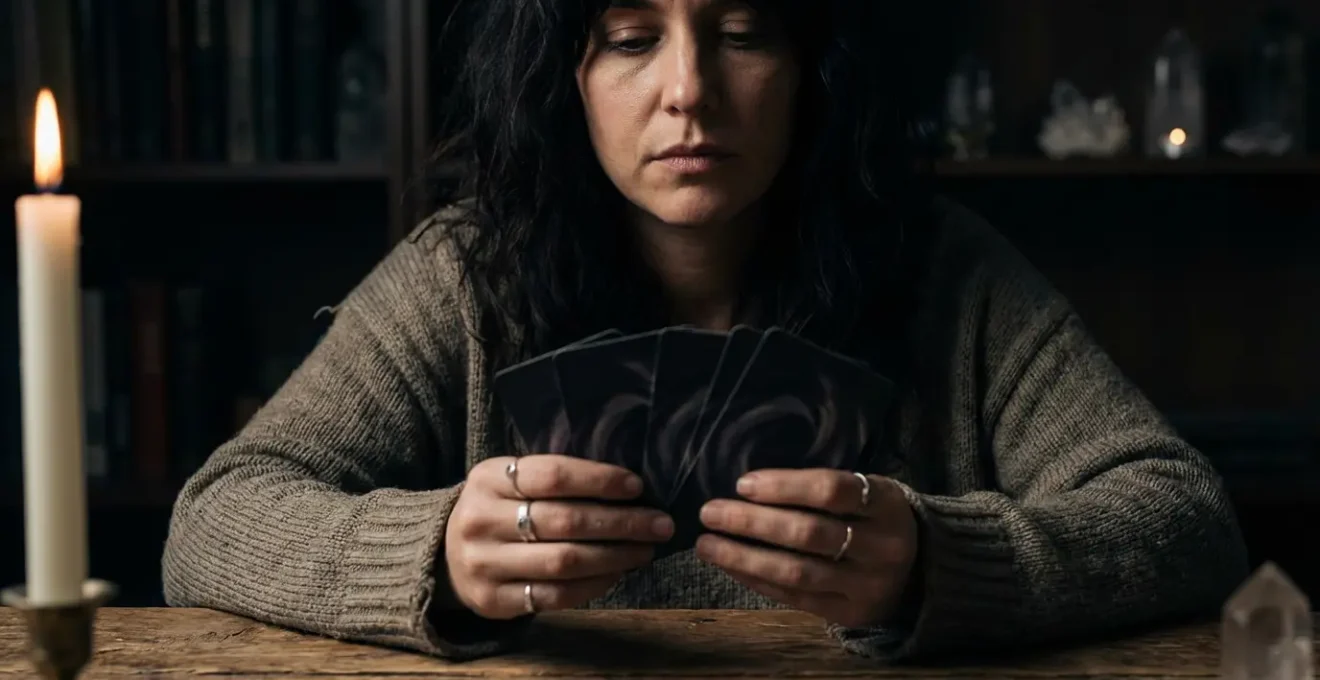
Contrary to popular belief, the goal isn’t to stop using predictive tools, but to fundamentally change how you use them to reclaim your emotional well-being.
- Prediction-induced anxiety is a biological reality rooted in your body’s stress response, not a sign of a doomed fate.
- The key is shifting from passive fear to active empowerment by choosing the right practitioners and reframing “bad” news as a call for growth.
Recommendation: Treat divination as a diagnostic tool for your inner world, not a deterministic script for your future.
It’s a familiar scenario for many: you open a popular astrology app, see a warning about a “challenging transit,” and a knot of dread tightens in your stomach. Or a tarot reading on social media shows a difficult card, and suddenly your day is cast in a shadow of impending doom. You might be told to “just relax, it’s for fun,” or to simply stop looking. But for those who genuinely seek guidance from these ancient tools, that advice feels dismissive and unhelpful. It ignores the very real anxiety that can hijack your peace of mind and turn a tool of insight into a source of fear.
The compulsive checking, the constant search for reassurance, the spiral of “what-if” scenarios—these are symptoms of a deeper issue. The common approach is to blame the prediction or the practice itself. But what if the true key isn’t to reject these tools, but to completely revolutionize your relationship with them? What if the anxiety they trigger isn’t a crystal ball showing a terrible future, but a mirror reflecting your current emotional state and inner vulnerabilities?
This guide is built on that premise. We will move beyond the platitudes and explore a new framework for engaging with astrology and divination. We won’t just tell you to set boundaries; we will show you how to build them from the inside out. This article will guide you through understanding the biological roots of prediction anxiety, provide immediate grounding techniques, and equip you with long-term strategies to transform your practice from one of fearful anticipation to one of conscious empowerment. We will explore how to reframe difficult news, differentiate intuition from anxiety, and ultimately, use these spiritual tools to build resilience, not dependence.
This article provides a structured path to help you navigate the world of predictive arts with confidence and calm. The following sections break down the problem and offer concrete, empowering solutions.
Summary: A Guide to Using Predictive Arts Without Spiraling
- Why Knowing the Future Can Sometimes Increase Your Cortisol Levels?
- How to “Close the Portal” and Return to Reality After an Intense Prediction?
- Empowerment vs. Doomscrolling: Choosing the Right Astrologer for Your Mental Health
- The Addiction Cycle: Signs You Are Depending Too Much on Tarot or Astrology
- How to Reframe a “Difficult Year” Prediction as a “Building Year”?
- The Danger of Obsessing Over a “Death” Card or 8th House Transit
- Intuition or Anxiety: Which One Is Driving Your Hesitation?
- Syncing With the Moon: A 28-Day Guide to Stabilizing Emotional Peaks
Why Knowing the Future Can Sometimes Increase Your Cortisol Levels?
The visceral, heart-pounding anxiety you feel after a dire prediction isn’t “all in your head.” It’s a deeply biological event. When your brain perceives a threat—whether it’s a tiger in the grass or a tweet about Saturn entering your 7th house—it doesn’t always distinguish the level of immediate danger. It simply triggers the hypothalamic-pituitary-adrenal (HPA) axis, your body’s central stress response system. This floods your system with cortisol, the primary stress hormone, preparing you for “fight or flight.”
For an anxious individual, a negative prediction acts as a potent, personalized threat. It’s not an abstract danger; it’s a forecast of personal suffering. This anticipation of pain can keep the HPA axis on high alert, creating a chronic state of stress. The anxiety itself becomes a self-fulfilling prophecy on a physiological level. A 2024 study published in Biological Psychiatry confirmed a direct link, finding that morning plasma cortisol was associated with anxiety with an odds ratio of 1.16 per cortisol z-score. This means the more elevated your baseline cortisol, the higher your likelihood of experiencing anxiety.
This is why simply “not worrying” is ineffective advice. You are fighting a powerful biochemical current. The key is not to invalidate the feeling but to understand its origin. The anxiety isn’t a psychic confirmation of doom; it’s an emotional barometer signaling that your nervous system is already dysregulated. The prediction is merely the catalyst, not the root cause. Understanding this allows you to shift your focus from fearing the future to tending to your present physiological and emotional state.
How to “Close the Portal” and Return to Reality After an Intense Prediction?
An intense reading, whether it’s with an astrologer or your own tarot deck, can feel like opening a portal to another dimension. You’re swimming in symbols, archetypes, and potent emotional currents. The problem arises when you forget to consciously close that portal. Without a proper grounding ritual, the energetic residue of the reading can cling to you, allowing fear and obsessive thoughts to bleed into your reality. Creating a simple “closing” ceremony is a crucial act of predictive hygiene.
This isn’t about complex magic; it’s about signaling to your mind and body that the session is over and you are returning to the present moment. It’s about creating a firm boundary between the symbolic realm and your lived reality. This can be as simple as saying “The reading is complete” out loud, washing your hands, or putting your cards away in a specific box. The most effective rituals involve physical sensation, as they pull your awareness out of the abstract mind and back into the tangible body.

Holding a grounding object, like a smooth stone or a piece of wood, can be incredibly effective. Focus on its texture, its temperature, its weight in your hand. This simple act of sensory focus anchors you in the “here and now.” It breaks the mental loop of future-tripping and reminds your nervous system that you are safe in this present moment. The goal is to consciously shift your state. As one practitioner shared in Spirituality+Health Magazine after a reading:
By the time I finished this reading, not only was I re-centered, but I was ready and willing to go back in the house, now armed with empowering insights: that I should relax and trust life; that pain can also make me alert; that a spinning mind rarely says anything helpful.
– Anonymous practitioner, Spirituality+Health Magazine
This is the essence of closing the portal: you don’t just walk away, you consciously transition back into your life, armed with insight but free from lingering energetic static.
Empowerment vs. Doomscrolling: Choosing the Right Astrologer for Your Mental Health
Not all predictive practitioners are created equal, especially when it comes to supporting your mental health. The wrong kind of reader can amplify anxiety, foster dependency, and leave you feeling powerless. The right kind can serve as a valuable guide, helping you navigate challenges with agency and resilience. The difference often lies in their communication style. Understanding this distinction is the first step in the Empowerment Framework: choosing your guides wisely.
Think of it as the difference between a “Judge” and a “Weather Reporter.” The Judge delivers deterministic verdicts: “You *will* have a difficult year,” “This relationship *is* doomed.” This language removes your free will and casts you as a passive victim of fate, which is a recipe for anxiety. The Weather Reporter, on the other hand, presents cosmic energies as environmental conditions: “The forecast looks stormy, so you might want to bring an umbrella and plan a route with good shelter.” They empower you with information so you can make informed choices.
A mental health-conscious practitioner will always prioritize your agency. They frame challenging transits as opportunities for growth, focus heavily on solutions and coping strategies, and remind you that you are the ultimate authority in your own life. Before booking a reading, audit their language on their website or social media. Are they making dramatic, fear-based proclamations, or are they offering thoughtful, nuanced guidance? The table below, inspired by this concept, breaks down what to look for.
| Aspect | Weather Reporter Style | Judge Style | Mental Health Impact |
|---|---|---|---|
| Language Pattern | “The forecast suggests…” “You might want to consider…” |
“You will experience…” “This is your fate…” |
Empowering vs. Disempowering |
| Client Agency | Maintains free will Offers choices |
Deterministic verdicts No alternatives |
Reduces anxiety vs. Increases helplessness |
| Difficult Transits | Frames as opportunities Provides coping strategies |
Presents as unavoidable suffering No solutions offered |
Builds resilience vs. Creates fear |
| Solution-to-Problem Ratio | 50/50 balance | 90% problems, 10% solutions | Action-oriented vs. Paralysis-inducing |
Choosing a “Weather Reporter” is an act of self-respect. It’s a declaration that you are not seeking a script for your life, but a map to help you navigate it more wisely.
The Addiction Cycle: Signs You Are Depending Too Much on Tarot or Astrology
There’s a fine line between using predictive tools for healthy self-reflection and falling into a cycle of dependency. This cycle often begins innocently, driven by uncertainty and a desire for control. In a world of increasing complexity, the appeal of a cosmic shortcut is strong. According to the National Science Foundation, more Americans considered astrology scientific in 2012 than they did in 1983, indicating a growing cultural acceptance and reliance on these systems.
The addiction cycle is fueled by the same mechanism as a slot machine: intermittent reinforcement. An occasional accurate or insightful reading delivers a dopamine hit of validation and certainty, which your brain craves. You start checking your horoscope more frequently, pulling “just one more card,” or scrolling endlessly through social media for a prediction that resonates. This is especially potent in the age of social media, where algorithms are designed to keep you engaged. A quick search on TikTok for “Astrologer Predicts 2024 Election” for instance, yields 28.3 million hits, demonstrating the sheer volume and demand for predictive content during times of high anxiety.
How do you know if you’ve crossed the line? Here are some key signs:
- Decision Paralysis: You feel incapable of making a decision, big or small, without consulting a chart or a card.
- Reassurance Seeking: You use readings not for insight, but to soothe immediate anxiety, often asking the same question repeatedly until you get the answer you want.
- Outsourcing Intuition: You trust the words of a reader or an app more than your own inner voice and judgment.
- Emotional Volatility: Your entire mood for the day is dictated by a positive or negative forecast.
- Financial or Time Drain: You are spending an excessive amount of time and money on readings, often to the detriment of other areas of your life.
Recognizing these patterns is not a cause for shame, but a call for awareness. It’s a signal that the tool has started to control you, rather than the other way around. It’s time to take a step back and re-establish your sovereign interpretation and personal authority.
How to Reframe a “Difficult Year” Prediction as a “Building Year”?
Few things can trigger anxiety like the prediction of a “difficult year,” a Saturn return, or a challenging 8th house transit. The mind immediately jumps to loss, struggle, and pain. But this is a failure of imagination, not a certainty of fate. The most powerful skill you can cultivate in your spiritual practice is the art of the reframe. Instead of seeing a year of demolition, you can choose to see it as a year of renovation. A “difficult year” becomes a “building year.”
This reframe isn’t about toxic positivity or ignoring real challenges. It’s a strategic shift in perspective. A building year is when the universe reveals the faulty foundations in your life—in your career, relationships, or self-worth—not to punish you, but so you can rebuild them stronger. It’s a year for deep, foundational work. The “difficulties” are not random punishments; they are the curriculum. A financial challenge is a masterclass in budgeting. A relationship breakdown is a seminar on boundaries. A career setback is a workshop on true purpose.

This perspective shifts you from a place of passive dread to active participation. You are no longer waiting for the sky to fall; you are a contractor showing up to the job site, ready to work. It’s about meeting the energy with intention. The Stoic philosophers had a practice for this called *Premeditatio Malorum*, or the premeditation of evils. They would visualize worst-case scenarios not to wallow in fear, but to mentally prepare, strategize, and rob those events of their power to shock and paralyze. You can apply this same principle to your astrological forecasts.
Your Action Plan: The Stoic’s Toolkit for Astrological Challenges
- Practice Premeditatio Malorum: Visualize potential challenges not to dwell, but to strategically prepare contingency plans.
- Identify Your ‘Saturnian Structures’: Audit weak areas in career, relationships, and health that cosmic challenges might highlight for strengthening.
- Create a Skill Acquisition Framework: Frame each predicted difficulty as curriculum (e.g., a financial challenge becomes a budgeting mastery opportunity).
- Implement the ‘Building Block’ Method: Break the ‘difficult year’ into quarterly goals focused on foundation-building rather than external achievement.
- Document Growth Metrics: Actively track not just challenges but also skills gained, resilience built, and wisdom acquired throughout the period.
By adopting this mindset, you turn a prophecy of fear into a plan for growth. You are no longer just a character in the story; you are its co-author.
The Danger of Obsessing Over a “Death” Card or 8th House Transit
Certain symbols in tarot and astrology are uniquely charged with fear. Pulling the Death or Tower card, or seeing a heavy transit through the 8th house (traditionally associated with death, taxes, and transformation), can send even a seasoned practitioner into a spiral of anxiety. The immediate, literal interpretation of “death” hijacks the brain. However, obsessing over these symbols is one of the most significant misunderstandings in divination.
In 99% of readings, these symbols do not predict a literal, physical death. They represent endings, transformation, and rebirth. The Death card is about the necessary end of a chapter—a job, a relationship, an old belief system—to make way for something new. The Tower represents a sudden, shattering breakthrough of truth that destroys false structures. The 8th house is about deep psychological work, confronting your shadow, and emerging transformed. These are not punishments; they are invitations to a profound level of personal evolution.
The anxiety comes from our ego’s resistance to change. The ego loves stability and predictability, and these symbols represent radical, non-negotiable shifts. As tarot reader Asali of Asali Earthwork advises, the key is to face the message rather than run from it:
For example, receiving the Nine of Swords might be alarming. Try not to shy away if you can, instead transmute its message. For the Nine of Swords, often the nightmare card, take it on its face, and if it is a nightmare, it means you can wake up from it.
– Asali, Asali Earthwork – Tarot Spread for Working With Anxiety
This perspective is increasingly supported by the mental health community. In fact, more and more psychologists use cards in their therapy sessions, leveraging their archetypal power. Carl Jung himself noted their connection to the “archetypes of mankind.” This therapeutic lens sees the Death card not as a threat, but as an opportunity to ask, “What part of my life needs to end so that I can be reborn into a more authentic version of myself?” This question transforms fear into a powerful prompt for self-inquiry.
Intuition or Anxiety: Which One Is Driving Your Hesitation?
One of the most confusing challenges for anyone on a spiritual path is distinguishing the quiet, clear voice of intuition from the loud, chaotic chatter of anxiety. Anxious individuals are particularly vulnerable to this confusion. A knot in your stomach before a big decision—is it a genuine intuitive warning, or is it just your fear of the unknown? This distinction is critical, because acting on anxiety as if it were intuition leads to paralysis and missed opportunities.
Intuition and anxiety speak different languages, even if they sometimes manifest in similar parts of the body. Anxiety is constrictive and loud; intuition is expansive and quiet. Anxiety feels scattered, frantic, and is often accompanied by a racing heart and shallow breath. It generates repetitive, spiraling “what if” scenarios about the future. Intuition, by contrast, feels calm, centered, and solid. It’s a deep “knowing” that doesn’t need to yell. It delivers a clear, singular message that is focused on the present moment or the next right step.
As clinical psychologist Dr. Chloe Carmichael notes, engaging with tools like tarot can be a way to create space to parse these feelings, stating that spiritual connection is associated with greater well-being, even when controlling for other factors. This practice of self-reflection helps you learn the unique signature of your own inner voice versus your fear. The following table offers a guide to help you discern which voice is speaking.
| Aspect | Intuition | Anxiety |
|---|---|---|
| Physical Sensation | Calm, centered feeling “Knowing” in the gut Feeling of peace |
Scattered, high-energy signals Racing heart Shallow breath, chest tightness |
| Quality of Thought | Expansive and opening Clear, singular message |
Constrictive and repetitive Spiraling, multiple worries |
| Time Orientation | Present-focused Next right step clarity |
Future catastrophizing “What if” scenarios |
| Decision Impact | Leads to confident action Even difficult choices feel right |
Creates paralysis Endless second-guessing |
The next time you feel a strong sense of hesitation, pause. Instead of immediately believing the fear, use this checklist as a diagnostic tool. Is the feeling contracting or expanding you? Is it loud or quiet? Learning to identify the source of the signal is a superpower that allows you to navigate your life with clarity and confidence.
Key Takeaways
- Your anxiety in response to a prediction is a valid biological reaction, not a confirmation of a doomed prophecy.
- True empowerment comes from actively reframing difficult predictions as growth opportunities, not from avoiding them.
- You are the ultimate authority in your life; treat practitioners as advisors and predictive tools as maps, not as deterministic scripts.
Syncing With the Moon: A 28-Day Guide to Stabilizing Emotional Peaks
After learning to manage acute moments of prediction anxiety, the final piece of the puzzle is establishing a long-term practice for emotional self-regulation. Instead of living in a reactive state, bouncing from one astrological forecast to the next, you can create a proactive rhythm that builds resilience. One of the most ancient and effective ways to do this is by syncing your personal energy with the lunar cycle. The moon’s 28-day journey through its phases provides a reliable, cyclical framework for setting intentions, taking action, and processing emotions.
Working with the moon moves you out of the linear, often anxious, mindset of “what will happen next?” and into a cyclical understanding of growth. Each phase has its own archetypal energy and corresponding task. This creates a predictable container for your emotional life, helping to stabilize the peaks and valleys of anxiety. Instead of being at the mercy of random transits, you have a consistent practice to return to, grounding you in a natural, recurring rhythm.
This is not about adding more rules, but about creating a gentle structure for self-reflection and intentional action. It’s a way to practice the skills of reframing and self-inquiry on a consistent basis. Here is a simple guide to aligning your emotional regulation tasks with the moon’s phases:
- New Moon: The time for planting seeds. Set one concrete, achievable intention for the coming cycle. Write it down.
- Waxing Moon (Crescent to First Quarter): The energy is building. Take the first brave, practical steps toward your intention. Initiate action.
- Full Moon: A time of peak energy, illumination, and release. Celebrate the progress you’ve made, and consciously forgive yourself or others to release accumulated tension.
- Waning Moon (Gibbous to Last Quarter): The energy is receding. This is a time for gratitude, reflection, and letting go of what didn’t work. Declutter your space, your inbox, or your social media feed.
- Dark Moon: The period just before the New Moon. This is the most crucial phase: rest. Do not force action. Reflect on the insights from the completed cycle and allow yourself to simply be.
By engaging with this cycle, you are teaching your nervous system that every phase—even the dark and quiet ones—has a purpose. You learn to trust the process of ebb and flow, which is the ultimate antidote to the anxiety of anticipation.
Your journey with predictive arts doesn’t have to be a rollercoaster of fear and fleeting reassurance. Your next step is not to swear off astrology or tarot, but to approach your next reading with a new intention: to seek insight, not certainty, and to reclaim your power as the true author of your story.